AI-assisted code review without lowering quality
Use AI to widen the review surface while keeping engineering judgment, automated checks and human accountability in control

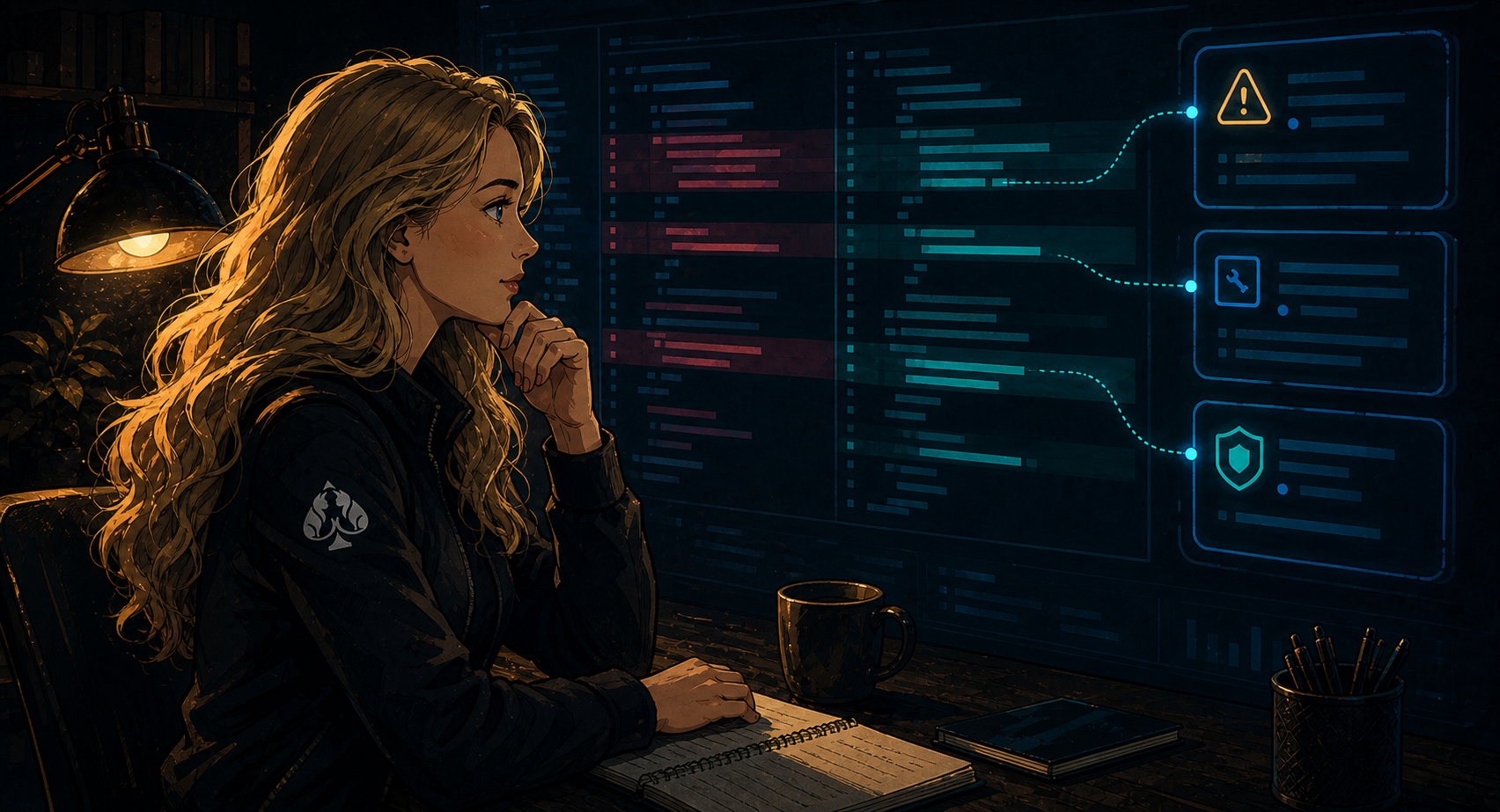
AI can make code review faster, broader and more consistent. It can also produce a confident comment that is irrelevant, incomplete or simply wrong. The useful question is therefore not whether an AI can review code. It is how to place AI inside an engineering system that continues to protect quality when the model makes a mistake.
The safest answer is to treat AI as an additional reviewer, not as the approval authority. It can inspect a change early, identify candidates for deeper investigation and reduce repetitive work. Tests, static analysis, security controls and a responsible human reviewer still decide whether the change is ready.
AI is a second pair of eyes, not a quality gate
AI review is particularly useful for a first pass over a pull request. It can summarize a diff, notice inconsistent error handling, propose edge cases, point to duplicated logic and ask whether a test covers an important branch. These are review leads: each one gives the human reviewer somewhere useful to look.
They are not proof. GitHub's own documentation for AI code review says that the system is not guaranteed to find every problem, can make mistakes and should be supplemented with human review. Recent original research reaches a compatible conclusion. The ContextCRBench code-review study found that richer textual context improves review performance, while the evaluated models remained far from human-level review ability.
This suggests a useful division of labor. Let the machine scan widely and tirelessly. Let deterministic tools enforce rules they can prove. Let a human evaluate intent, risk and tradeoffs.
Context determines whether a comment is useful
A diff rarely explains the whole change. Good review also depends on the requirement, surrounding code, data model, threat model, production constraints and team conventions. Without those inputs, an AI reviewer may correctly describe what the code does while missing that it does the wrong thing.
Consider this deliberately simplified Java authorization method:
public boolean canDownload(Document document, User user) {
  return document.isPublic() || user != null;
}
An AI can notice that every authenticated user receives access to every private document. But it cannot know the intended authorization policy from this method alone. Should access belong to the document owner, a project member, an administrator or some combination? The requirement is part of the evidence.
After the team supplies that policy, the implementation becomes reviewable against an explicit expectation:
public boolean canDownload(Document document, User user) {
  if (document.isPublic()) {
    return true;
  }

  if (user == null) {
    return false;
  }

  return document.ownerId().equals(user.id())
      || user.hasRole("DOCUMENT_ADMIN");
}
The improved method is not automatically correct. A reviewer still needs to confirm that the role exists, ownership cannot be forged, identifiers cannot be null and the policy has suitable tests. AI helped expose the question; engineering context resolves it.
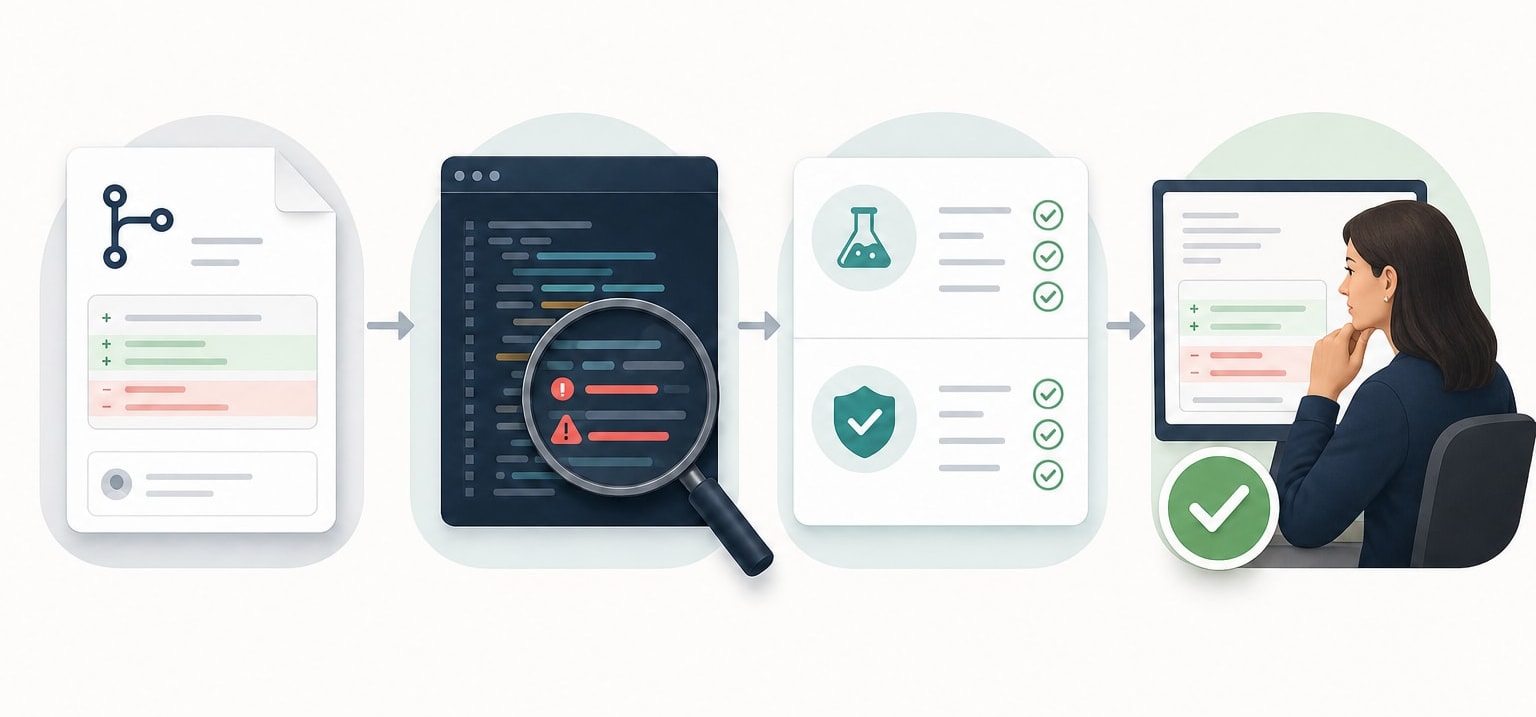
Build a layered review workflow
1. Make the pull request understandable
The author should explain why the change exists, what is deliberately out of scope, which risks deserve attention and how the result was tested. Keep pull requests focused enough that a reviewer can build a mental model. AI benefits from the same clarity as a human.
2. Run deterministic checks before asking for judgment
Compilation, tests, formatting, static analysis, dependency checks and policy validation should run automatically. Do not spend human or model attention rediscovering a failure that a repeatable tool can identify with certainty.
This layered approach also reflects the NIST Secure Software Development Framework, which recommends integrating secure development practices into the software lifecycle rather than relying on one final inspection.
3. Ask the AI focused questions
“Review this code” is an underspecified request. A focused review should identify the expected behavior and ask for evidence. Useful questions include:
- Which inputs can reach this change, including null and malformed values?
- Which authorization assumption does each branch enforce?
- What failure modes are not covered by the tests in this pull request?
- Could concurrency, retries or partial failure change the result?
- Which observation is certain, and which suggestion depends on missing context?
Ask the model to cite the relevant file and line, explain the failure scenario and distinguish findings from questions. This makes its output easier to verify and discourages vague commentary.
4. Require human review of intent and risk
The human reviewer owns the final decision. That review should cover the complete diff, not only the lines mentioned by AI. Architecture, maintainability, privacy, user impact and business rules are often where the most important mistakes hide.
Human review should become more demanding as risk increases. A copy change and an authorization change do not deserve the same process. Security-sensitive code, migrations, payment paths and deployment configuration should receive deeper review and independent evidence.
5. Verify suggested fixes as new code
An AI-generated fix is another untrusted change. Read the entire patch, run the checks again and add tests that would fail if the original defect returned. Never accept a suggestion merely because it addresses the review comment that the same model produced.
Protect the review system itself
AI coding tools can read repository files, pull-request descriptions, review comments and external pages. That context can contain mistakes or malicious instructions. The OWASP Secure Coding with AI Cheat Sheet recommends treating repository and review content as untrusted input, limiting tool access, reviewing unexpected changes and protecting credentials from the agent.
In practice, use least-privilege credentials and keep production secrets outside the repository. Flag changes to pipelines, dependency files, deployment scripts and agent instructions for heightened review. Confirm that a code-review assistant cannot silently approve, merge and deploy its own work.
Measure outcomes, not comment volume
A large number of AI comments can make a process feel thorough while slowing reviewers down. Start with a limited pilot and collect signals that reflect engineering outcomes:
- How many AI findings were accepted, rejected or already covered by tools?
- Did review time improve without increasing escaped defects?
- Which categories produced useful findings and which created noise?
- Did developers add stronger tests or merely resolve comments?
- Were security-sensitive changes still reviewed by the right people?
Use those observations to refine prompts, repository guidance and automation. If a deterministic rule can supersede a recurring AI comment, encode the rule in the pipeline. The AI reviewer should concentrate on ambiguity and relationships that are harder to express as fixed checks.
Keep the quality bar human-owned
AI-assisted review works best when it adds coverage without removing accountability. Give it the requirement and relevant context, ask focused questions, verify every claim and keep repeatable controls in the pipeline. Most importantly, preserve an independent human decision before high-impact code reaches production.
The goal is not an automated stream of comments. It is a better engineering conversation: one in which machines surface possibilities, tools establish facts and people remain responsible for the software they ship.
Share:
Our Story
A little bit about AceCat
We are AceCat, a software company with quality at heart.
We aim to provide new ideas, thoughts and expertise in the IT field.
Our goal is to educate, spread the knowledge and build a better future for all of us.
We discuss both hard-skill, technical topics from the Software Development world, and soft skill-related issues.


Contact us
Say HI!
If you like what you see or find something to be improved, contact us here:
Brought to you with

by AceCat
